For clinicians and coaches
You get one hour. The other 167 happen without you.
A week is 168 hours. You are in the room for one of them. Everything that actually moves a nervous system, the daily practice, the sleep, the repetition through a boring stretch, happens in the 167 you never see. This is what runs in those hours, and what tells you afterwards whether it happened.

The gap
Between-session work has never really been enforceable.
You send them home with a breathing protocol. Maybe a worksheet, maybe an app you do not control. At the next session you ask how it went, and you get a number they assembled in the parking lot, because they honestly do not remember. Clinical decisions are then made on self-report about a behavior nobody recorded.
The failure is usually not motivation. It is that autonomic training has no felt scoreboard. A client can breathe correctly for ten minutes and have no idea whether anything happened, so the practice quietly extinguishes somewhere in the second or third week. By the time you notice, you are asking them to restart rather than continue.
You cannot coach what you cannot see.
The mechanism
Resiliency trained the way strength is trained.
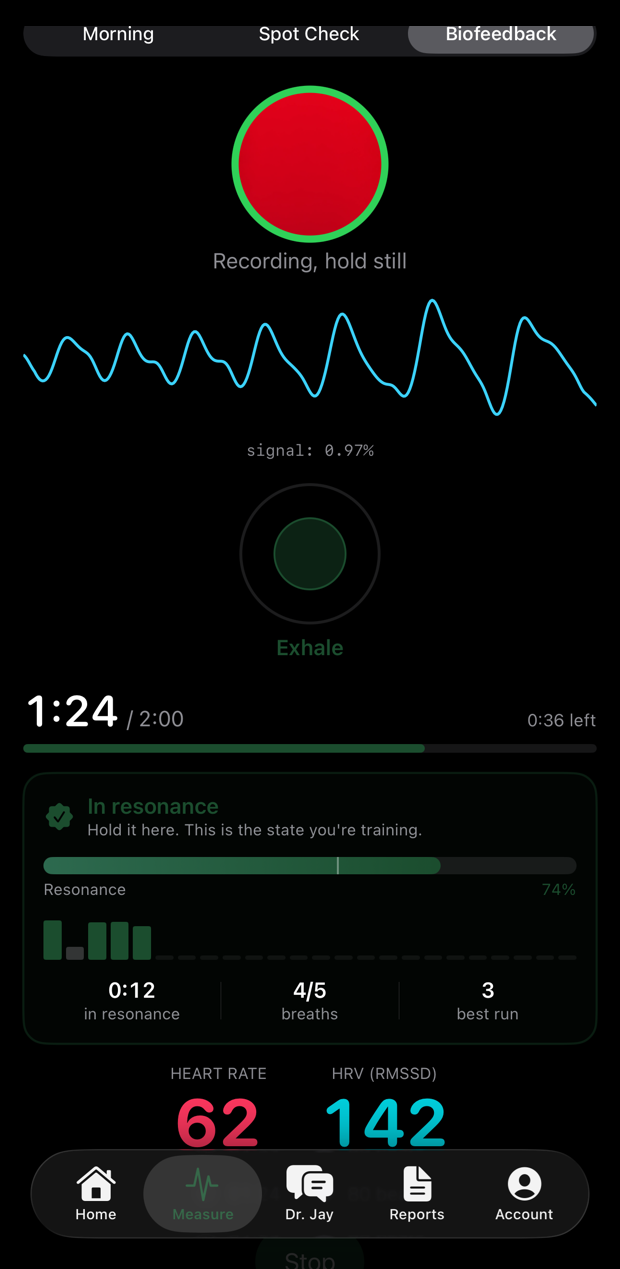
Not a meditation timer with a heart rate readout. A measurement layer that refuses bad data, an individually determined training target, and a daily practice with a score attached to every breath.
Most tools hand everyone six breaths per minute. The app runs a resonance frequency assessment on the Lehrer protocol and finds the rate where that individual's heart rate oscillations are actually largest. Training at someone else's rate is most of why paced breathing underdelivers.
Every range in the app is built from that client's own history. There are no population norms anywhere in it, because telling a 54 year old their RMSSD is below average for their age group is information they cannot act on and will worry about anyway.
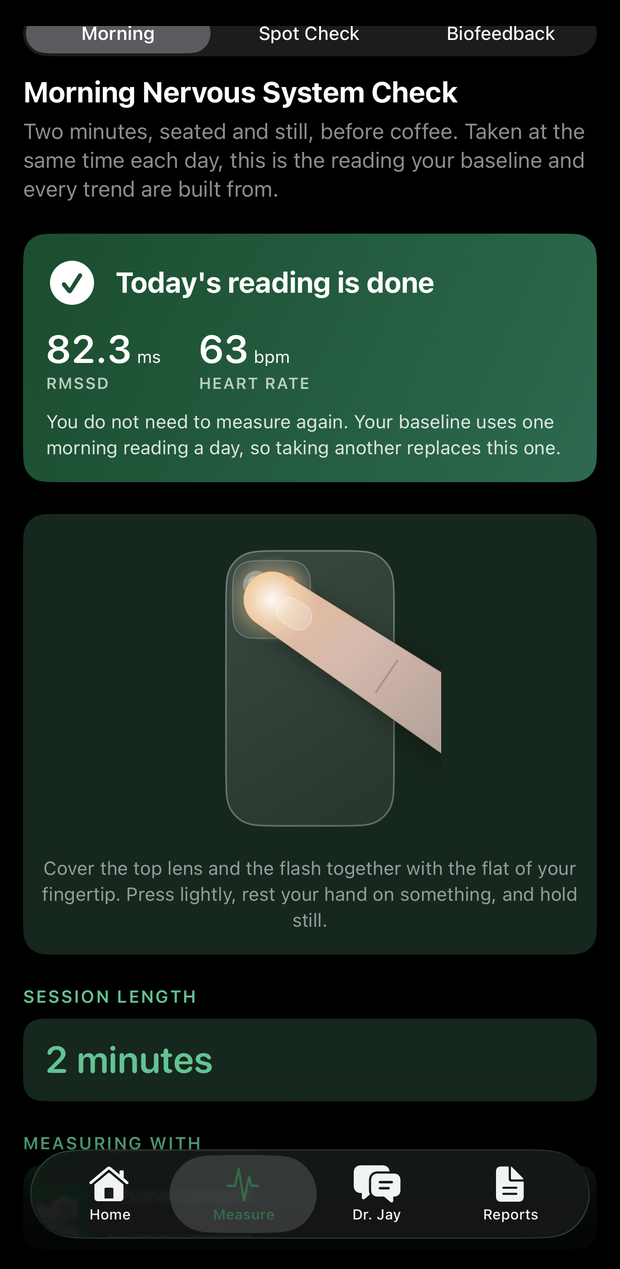
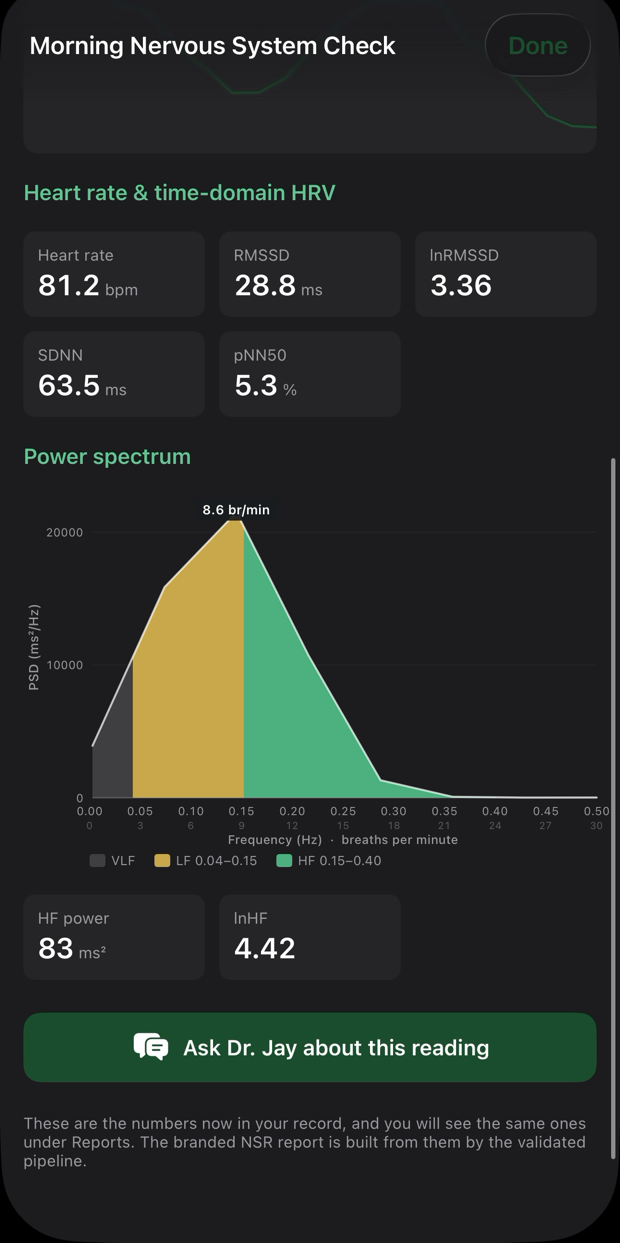
A two minute reading from the phone camera, validated against a chest strap with the error measured rather than assumed. Or any Bluetooth monitor that broadcasts beat to beat intervals: Polar, Kyto, Scosche, earbud and finger sensors alike. Your clients buy nothing.
Artifact rejection tuned against real recordings and known-bad data. A reading that cannot be cleaned is thrown out and labelled, never stored as a number that looks usable. You will not be handed a trend built on noise.
Adherence
You will know who practiced.
Not whether they say they practiced. Whether the reading exists.
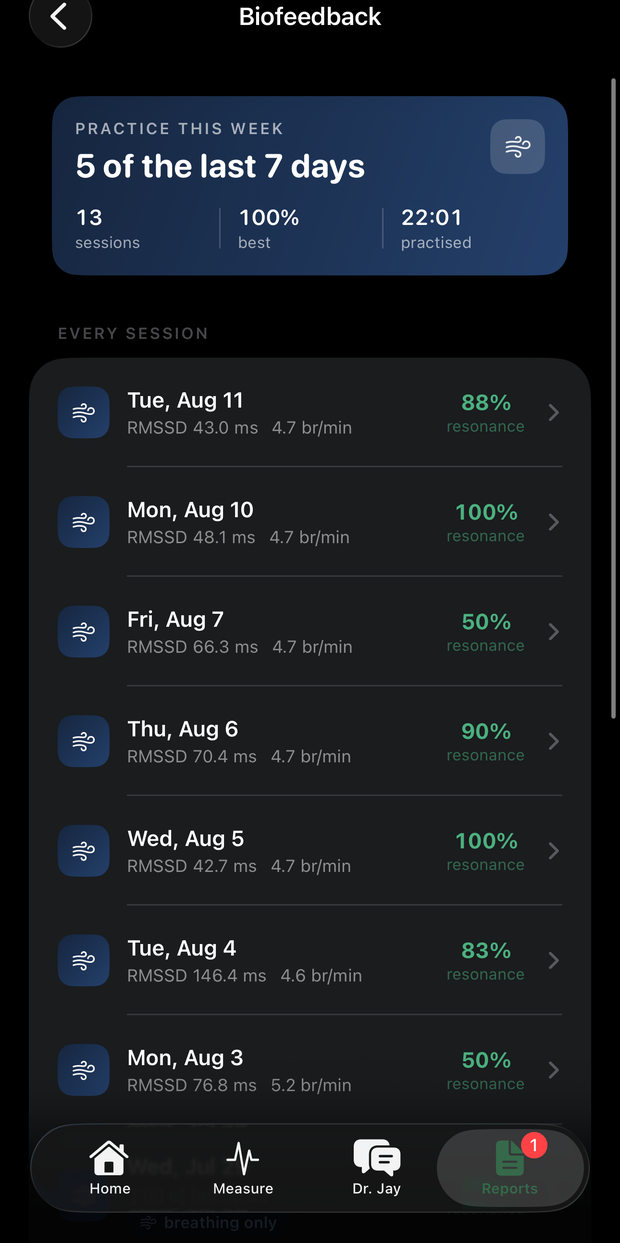
Every morning check and every training session is timestamped. You see the days they showed up, the days they did not, how long they held resonance once they were in it, and whether the trend across weeks is moving. The client sees the same thing, which is the part that keeps them going: the score is immediate, so the practice stops feeling like an article of faith.
Once a week and once a month the app writes a review from that client's own history. It reports what changed, what did not, and what to do next. I read those before they go out. The engine produces the numbers; a clinician decides whether what they are saying is right.
Friday's session opens with the data, not the recap.
What it does for you
Six things change the week you start.
They stay enrolled
Week three is where programs quietly end. A number that moves is the cheapest save you have.
Your program is worth more
Daily training and a reviewed report support a fee that a worksheet does not.
Prep takes two minutes
The weekly review arrives written. Read it on the way into the room.
You stop guessing
Adherence becomes a timestamp instead of a recollection.
Clients buy nothing
Fifteen seats come with yours. No second subscription for them to justify.
No commission, ever
You bundle it at your price. Nobody is paid to recommend anything.
The arithmetic
It has to earn its place.
Not a promise about your revenue. The honest version: what a seat costs set against what you already bill, and how little has to change before it has paid for itself.
4.6% of what you bill across those clients
To cover it, your caseload has to stay enrolled 8.3 client-months longer over the year. Across 15 clients that is 17 extra days each.
Whether it clears that bar is a question about your clients, not about this app, and you are better placed to answer it than I am. What I can tell you is where the extra weeks tend to come from.
The stretch where programs die
They have paid real money and cannot yet point to anything that changed. A number that moves is the cheapest thing you can put in front of them in that window.
Something they can feel working
Every breath is scored while they take it. Compliance stops depending on belief, which is what it depends on when the feedback is a monthly conversation.
You see the drift before the cancellation
Someone who has stopped reading in the mornings has usually decided something. You find out that week instead of at the next appointment they do not book.
What arrives on day one
Enough to start on Monday.
Practitioners adopt protocols, not products. The subscription includes the clinical scaffolding, not just access.
Settle, Prime and Anchor: ninety seconds, sixty, thirty. Written for anxiety, trauma-informed, and low arousal presentations, so the same tool does not get used the same way on everyone.
What to say when you hand it to a client, in language that does not overpromise and does not sound like an infomercial. The reason most clinicians never introduce a tool is that they have not decided how to describe it.
A thirty day assignment you can give as-is, client facing, with the daily commitment stated honestly at the top.
Deliberately conservative: who this is not for, where the measurement is not interpretable, the one physiological risk worth understanding, and the claims you should not make on my behalf or your own.
"Why we start sessions this way." Explains the mechanism to the person doing it, which is most of what makes them keep doing it.
Codes to enrol your clients, and a view across all of them: who read this morning, who has gone quiet, who is trending. Access is invite code only, so nobody arrives in your caseload by accident.

Why it is built this way
I am a clinician before I am a founder. Everything here exists because I needed it in my own practice first.
Pricing
One seat, fifteen clients, everything included.
A seat is one practitioner. It carries fifteen active clients, the full clinical kit, and the dashboard. Annual is two months free.
For scale: the app sells to individuals at $19.99 a month, so fifteen retail seats would be $3,598 a year. A practitioner seat is $2,490 with the clinical layer on top of it.
Founding practitioner
$1,990/year
Locked for life. Ten seats, then this rate is gone.
- Everything in Practitioner
- This price for as long as you keep the seat, including every future release
- Direct line to me, and a monthly call while the protocols are being finalized
- Your name on the founding cohort, if you want it there
Ten seats total. Available now.
Practitioner
$249/month
Or $2,490 a year, which is two months free.
- One practitioner seat, fifteen active clients
- The full clinical kit and session protocols
- Practitioner dashboard and invite codes
- Weekly and monthly client reports
- Additional clients at $12 each per month
Clinic
Multi-seat
Two or more practitioners under one account.
- Every seat carries its own fifteen clients
- One invoice, one renewal date, seats reassignable between staff
- Onboarding session for your team
- Protocol adapted to how your clinic actually runs
A four seat clinic is $9,960 a year. Most of these are a twenty minute conversation, so I would rather have it than sell you the wrong thing.
Clients never pay you or me separately. Their access comes out of your seat, which is the point: the tool arrives as part of your program rather than as one more subscription they have to justify.
Before you ask
The questions clinicians actually ask.
Do my clients have to buy anything?
No. Fifteen active client seats come with your subscription. You enrol them with an invite code, they install the app, and there is no payment step on their side at all.
Beyond fifteen it is $12 per additional client per month, against $19.99 if that person bought the app themselves.
What happens to a client if I cancel?
They keep their data and they are never locked out mid-protocol. The app is built so that a lapsed practitioner subscription cannot strand an active clinical client: they move to their own access rather than losing the account.
This is deliberate. Someone in week six of a training protocol should not have it stop because of a billing event between you and me.
Is this a medical device? What can I claim?
It is not a medical device and it does not diagnose or treat disease. The scope and contraindications page in the kit is deliberately conservative and states what should not be claimed, including by me.
What is defensible: HRV biofeedback and resonance breathing have a real literature behind them for autonomic regulation. What is not: any assertion about treating a diagnosis. If a claim would make you uncomfortable in a case note, it does not belong in a client conversation either.
What do I actually have to teach them?
Close to nothing. The app runs the resonance assessment, sets the rate, paces the breath and scores it. Your twenty second introduction and the client handout do the rest.
The clinical skill is not operating the app. It is deciding when to prescribe it, reading what comes back, and knowing when a flat trend means the protocol is wrong rather than the client is lazy. That is what the protocols and the monthly call are for.
What device do my clients need?
An iPhone. There is no Android version and no web version yet, which is a real constraint if your caseload skews Android and I would rather you know now.
Beyond that, nothing. The phone camera takes the reading. If a client already owns a Polar H10, Kyto, Scosche Rhythm or any monitor broadcasting beat to beat intervals, it will pair, but nobody has to buy hardware.
Do you pay referral commission?
No, and I will not. Paying clinicians to recommend a product is how a clinical tool turns into a multilevel marketing scheme, and every careful practitioner you would want using this can smell it.
The economics work the other way around. Seats are yours, you bundle them into your program at your price, and the margin is a normal part of what you charge for care rather than a payment from me.
Who is behind this?
Dr. Jay T. Wiles. Board certified in HRV biofeedback and peripheral biofeedback through the BCIA, co-founder of Hanu Health, Chief Health and Performance Officer at Ohm Health, and in clinical practice for over a decade.
The engine in this app is the one producing reports in my own practice. More on the background.
Getting started
Take a seat, or ask me anything first.
Solo seats are bought here and set up the same day. Anything multi-seat is a short conversation first, because clinics rarely need exactly what is on the shelf.
What happens next
- I read it and reply. Usually the same day, with a straight answer about whether this fits what you are doing. Sometimes that answer is no.
- You see it running. Either a short call or a recorded walkthrough of the dashboard and the protocols, depending on what you would rather.
- Payment by card, once you have decided. Your seat activates immediately and the kit arrives by email.
- You enrol your first clients. Invite codes, one per client. Most practitioners start with two or three rather than the whole caseload.
If you would rather just talk, reply to any email from me and we will find twenty minutes.